
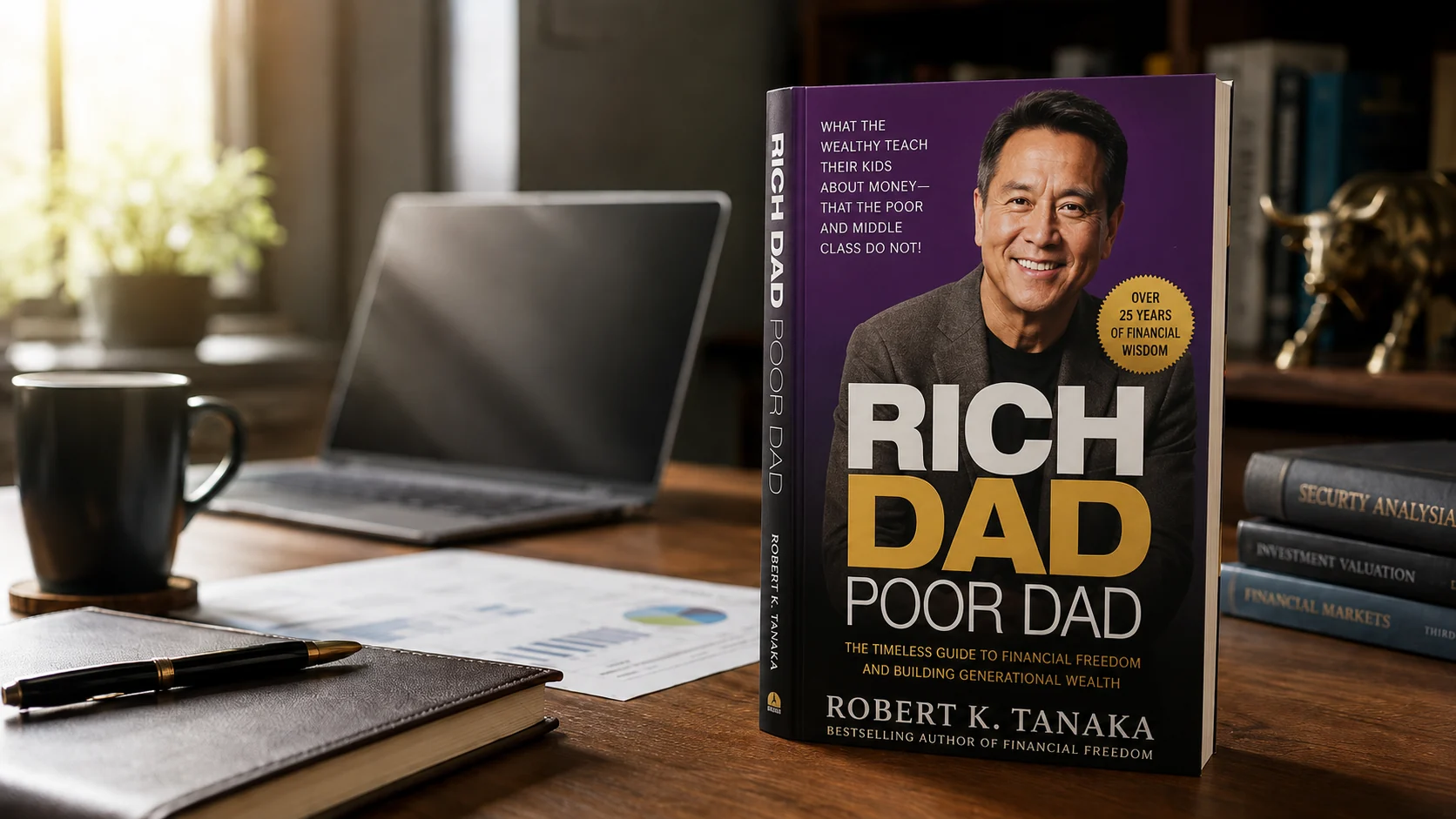
The Book That Made Millions Question Everything They Had Been Taught About Money
Most personal finance books tell readers how to manage money.
Rich Dad Poor Dad did something more disruptive: it asked whether the rules people were following were wrong in the first place.
When Robert Kiyosaki published the book in 1997, its central argument collided with a familiar version of the American dream. Study hard. Get a good job. Earn raises. Buy a home. Save money. Avoid risk. Work until retirement.
Kiyosaki presented another way of looking at the same life.
Through the contrasting financial philosophies of his highly educated “poor dad” and entrepreneurial “rich dad,” he argued that a large paycheck does not necessarily create wealth, that financial education matters as much as professional education, and that the real objective should be acquiring assets capable of producing income.
The Rich Dad organization says the book has sold more than 32 million copies since publication. Whatever readers think of Kiyosaki’s broader investment philosophy, few personal finance books have embedded concepts such as “assets versus liabilities” and “make money work for you” so deeply into popular financial culture.
Part of its staying power comes from something surprisingly simple.
Rich Dad Poor Dad does not begin with stock formulas.
It begins with behavior.
And that is where its seven most important lessons become interesting.
1. A High Income Can Make You Comfortable Without Making You Wealthy
One of Kiyosaki’s most provocative ideas is that earning a lot of money and becoming wealthy are two different achievements.
Imagine someone earning $200,000 a year.
From the outside, that person appears successful. But if virtually the entire salary disappears into a large mortgage, expensive vehicles, travel, credit cards and an increasingly costly lifestyle, very little permanent wealth may actually be accumulating.
Now imagine someone earning much less but consistently converting part of every paycheck into investments and other productive assets.
The second person can gradually build ownership while the first remains dependent on the next paycheck.
That difference sits near the center of Rich Dad Poor Dad.
Kiyosaki pushes readers to stop asking only, “How much money do I make?”
A better question is:
“What am I building with the money I make?”
Salary measures income.
Wealth measures what remains and what that capital can eventually do for you.
This distinction explains why some people receive raise after raise without ever feeling financially free. Income rises, but lifestyle rises beside it. The person becomes better paid without becoming significantly less dependent on employment.
The lesson is not that salaries are bad.
A strong salary can be an extraordinary wealth-building tool.
The mistake is treating income itself as the final destination.
2. Learn the Difference Between Things You Own and Things That Build Your Wealth
Few ideas from Rich Dad Poor Dad became more famous than Kiyosaki’s simplified distinction between assets and liabilities.
His framework focuses on cash flow.
An asset, in the Rich Dad model, tends to put money into your pocket. A liability tends to take money out. Rich Dad materials apply this thinking to rental properties, businesses, dividend-paying investments, royalties and other sources of recurring cash flow.
This is intentionally simpler than formal accounting.
Kiyosaki is trying to change the question people ask before buying something.
Instead of:
“Can I afford the payment?”
Think:
“What will this do to my cash flow?”
That shift can be surprisingly powerful.
A $70,000 vehicle may be something you own, but it can still require payments, insurance, maintenance and fuel every month.
A rental property can also cost money, carry risk and lose value—but if it reliably produces more income than its total expenses, it can contribute cash rather than simply consume it.
Kiyosaki famously applies this thinking to a primary residence, arguing that a home should not automatically be celebrated as an income-producing asset simply because you own it.
That claim is often misunderstood.
A home can clearly have substantial value, appreciate and create equity. Kiyosaki’s point is about cash-flow behavior: if something consistently requires money from you rather than generating income for you, do not confuse ownership with financial independence.
The deeper lesson is not to obsess over labels.
It is to examine where your money actually flows.
3. Build Your Asset Column Even If You Keep Your Day Job
“Mind your own business” is another idea in the book that sounds different from what Kiyosaki actually means.
He is not necessarily telling every reader to quit immediately and launch a startup.
He is telling them to build something financially separate from their profession.
Your profession might be software engineering.
Your job might be at Microsoft.
But your personal financial business is the collection of assets you are building outside your paycheck.
That might include a diversified investment portfolio, rental property, a small business, intellectual property or other assets appropriate to your knowledge and risk tolerance.
The distinction matters because employment income can disappear when employment disappears.
Ownership can potentially continue producing value.
Someone can therefore spend 30 years becoming exceptional at a career and still use part of the income from that career to accumulate assets.
That creates a gradual transition.
At first, your job produces almost all of your income.
Later, investments may contribute something.
Eventually, if enough productive capital is accumulated, ownership can begin supporting a meaningful portion of your lifestyle.
Kiyosaki’s ultimate objective is not unemployment.
It is optionality.
Work becomes different when you do it because you choose to, rather than because missing the next paycheck would immediately create a crisis.
4. Pay Yourself Before Your Lifestyle Takes Everything
Most people handle money in this order:
Income arrives.
Bills get paid.
Life happens.
Whatever is left gets saved or invested.
Often, nothing is left.
Rich Dad Poor Dad attacks that pattern through the idea of paying yourself first.
The Rich Dad framework treats money designated for saving and asset building as a priority rather than the leftovers of consumption.
There is an important practical nuance here.
This principle should not be interpreted as permission to ignore legally owed bills, miss debt payments or create financial chaos merely to invest.
The useful version is behavioral.
Make wealth building part of the system before discretionary spending expands to consume everything.
A worker who automatically directs part of each paycheck toward retirement accounts, investments or financial reserves has changed the default.
Instead of asking every month whether there is enough discipline left to invest, investing happens before dozens of smaller spending decisions have a chance to compete for the money.
This becomes even more powerful when income rises.
Suppose your monthly take-home income increases by $1,000.
Lifestyle inflation would happily consume all $1,000.
But if $400 is automatically redirected toward investments before your lifestyle adapts, you still experience a $600 improvement in monthly spending power while simultaneously accelerating wealth creation.
That is the quiet battle Kiyosaki wants the reader to notice.
Your future financial life and your present lifestyle are competing for the same dollar.
If the future always receives what is left over, the present usually wins.
5. Work to Learn, Not Only to Earn
One of the book’s most underrated lessons has little to do with buying investments.
It is about skills.
People naturally evaluate jobs according to salary, title and benefits.
Kiyosaki argues that another question can sometimes be even more valuable:
What will this job teach me?
A technically brilliant person may understand a product but have no idea how to sell it.
A gifted employee may understand operations but know nothing about accounting.
Someone may understand investing but be incapable of negotiating.
Another person may possess a great business idea but lack the communication skills necessary to convince customers, employees or investors to care.
Kiyosaki emphasizes building a broad financial and entrepreneurial toolkit rather than becoming so specialized that your income depends entirely on one narrow ability.
Sales.
Accounting.
Marketing.
Negotiation.
Investing.
Leadership.
Understanding financial statements.
These skills can interact.
Someone who understands a business opportunity but cannot evaluate the numbers is vulnerable.
Someone who understands numbers but cannot sell may struggle to turn an idea into revenue.
Someone who earns well but cannot allocate capital may spend decades generating income without converting much of it into wealth.
The lesson is not that specialization is bad.
Specialized expertise can generate enormous income.
The point is that income-producing skill and wealth-building skill are not automatically the same thing.
Learning both can dramatically expand your choices.
6. Fear and Desire Can Quietly Control Your Financial Life
Some of the most memorable parts of Rich Dad Poor Dad are psychological.
Kiyosaki argues that fear and desire drive many financial decisions.
Fear encourages people to cling to a paycheck because losing it feels dangerous.
Then money arrives.
Desire takes over.
A bigger paycheck creates a bigger lifestyle. New purchases create new expenses. Those expenses make the paycheck even more necessary.
The person becomes trapped in a loop:
work → earn → spend → need to work again.
Kiyosaki calls this part of the “rat race.”
It is easy to interpret the phrase as an attack on ordinary employment, but the more useful interpretation is about dependence.
If your entire financial life requires next month’s labor income to function, you have very little room for error.
This is where financial reserves, manageable fixed expenses and investments become more than numbers on a spreadsheet.
They create choices.
Fear also appears when investing.
Markets fall and people panic.
An investment rises rapidly and greed takes over.
Everyone seems to be getting rich and suddenly risk feels invisible.
Investor.gov emphasizes that all investments involve some degree of risk and that factors such as diversification, asset allocation, time horizon and individual risk tolerance matter when constructing a portfolio.
Kiyosaki’s broader psychological lesson survives even if a reader disagrees with some of his specific investment preferences:
Money decisions made primarily from fear or greed are rarely being made from clarity.
Financial education gives you more tools to recognize what emotion is trying to make you do.
7. Financial Education Helps You See Opportunities Other People Miss
Perhaps the biggest idea connecting everything in Rich Dad Poor Dad is Kiyosaki’s belief that financial intelligence changes what you can see.
Two people can look at the same situation and see completely different things.
One sees an old property.
Another sees the potential cash flow after renovation costs, financing, vacancies and maintenance.
One sees a small business.
Another studies revenue, margins, customer acquisition and whether the company can operate without the founder.
One sees a stock that has fallen 30%.
Another asks whether the underlying business deteriorated or whether the price simply changed.
None of those observations guarantees a profitable investment.
That is precisely why knowledge matters.
Opportunities and traps can look remarkably similar before the numbers are understood.
Rich Dad’s broader financial-literacy framework places heavy emphasis on understanding cash flow, different forms of income, debt, investing, risk and financial statements before deploying capital.
This may be the book’s most durable idea.
Money itself is not enough.
Someone can inherit money and lose it.
Earn an enormous salary and spend it.
Receive a business opportunity and misjudge it.
Borrow money and use leverage badly.
Capital amplifies decisions.
Financial education improves the quality of those decisions.
That does not mean educated investors never lose money. They absolutely do.
It means the objective is to understand enough to know why you are taking a risk before you take it.
What Rich Dad Poor Dad Gets Right—and Where Readers Should Be Careful
The enormous influence of Rich Dad Poor Dad does not mean every sentence should become a personal financial commandment.
Some of Kiyosaki’s language is deliberately provocative.
The idea that a home is not an asset becomes more useful when understood as a cash-flow thought experiment rather than a universal rule.
His enthusiasm for entrepreneurship, real estate, leverage and active financial control may also be inappropriate for someone who does not have the experience, temperament or financial position required to manage those risks.
Debt is especially important.
Borrowing can magnify a successful investment.
It can also magnify a bad one.
And while Kiyosaki emphasizes acquiring assets, investors still need to think about diversification. Concentrating too much wealth in one property, company or investment can expose an entire financial future to one failure. Investor.gov identifies diversification and asset allocation as important tools for managing investment risk.
The strongest way to read Rich Dad Poor Dad is therefore not as a step-by-step investment manual.
It is as a challenge to your assumptions.
Why do you believe a salary equals security?
Why do you buy what you buy?
How much of your income becomes assets?
Could you survive without your next paycheck?
Are your financial decisions expanding your options or shrinking them?
Do you understand the investments you own?
Those questions are more valuable than blindly copying someone else’s portfolio.
Why the Book Still Resonates Decades Later
The world of money has changed dramatically since Rich Dad Poor Dad appeared in 1997.
Investors can buy diversified funds from a phone. Online businesses can reach customers around the world. Financial information that once required professionals is available in seconds.
But human behavior has not evolved nearly as quickly.
People still confuse income with wealth.
They still increase spending when income rises.
They still buy things because other successful people appear to own them.
They still chase investments after prices explode and panic after markets fall.
And millions still reach adulthood knowing how to earn a paycheck but very little about cash flow, investing, debt or financial statements.
That is the territory where Kiyosaki’s book remains powerful.
Its biggest contribution was never a specific investment.
It was changing the reader’s perspective from:
“How can I earn more money?”
to:
“How can I build things that produce money?”
That is a very different question.
The first focuses on labor.
The second introduces ownership.
The first can improve your lifestyle.
The second can eventually change how dependent your lifestyle is on your labor.
Neither happens automatically, and neither guarantees wealth.
But once a reader understands the distinction, it is difficult to look at money exactly the same way again.
Rich Dad Poor Dad is most valuable when it makes the reader uncomfortable enough to examine their own financial assumptions. Its ideas about assets, cash flow, financial education and making money work for you are simple to understand but much harder to practice consistently—which is exactly why the book can remain useful long after the final page.
Sources
Rich Dad — The Rich Dad Guide to Personal Finance
Rich Dad — Foundations of Financial Literacy
Investor.gov — Introduction to Investing
This article was written by the owner of Finance Atlas. The information presented was researched using the authoritative sources listed above.
Continue Reading