
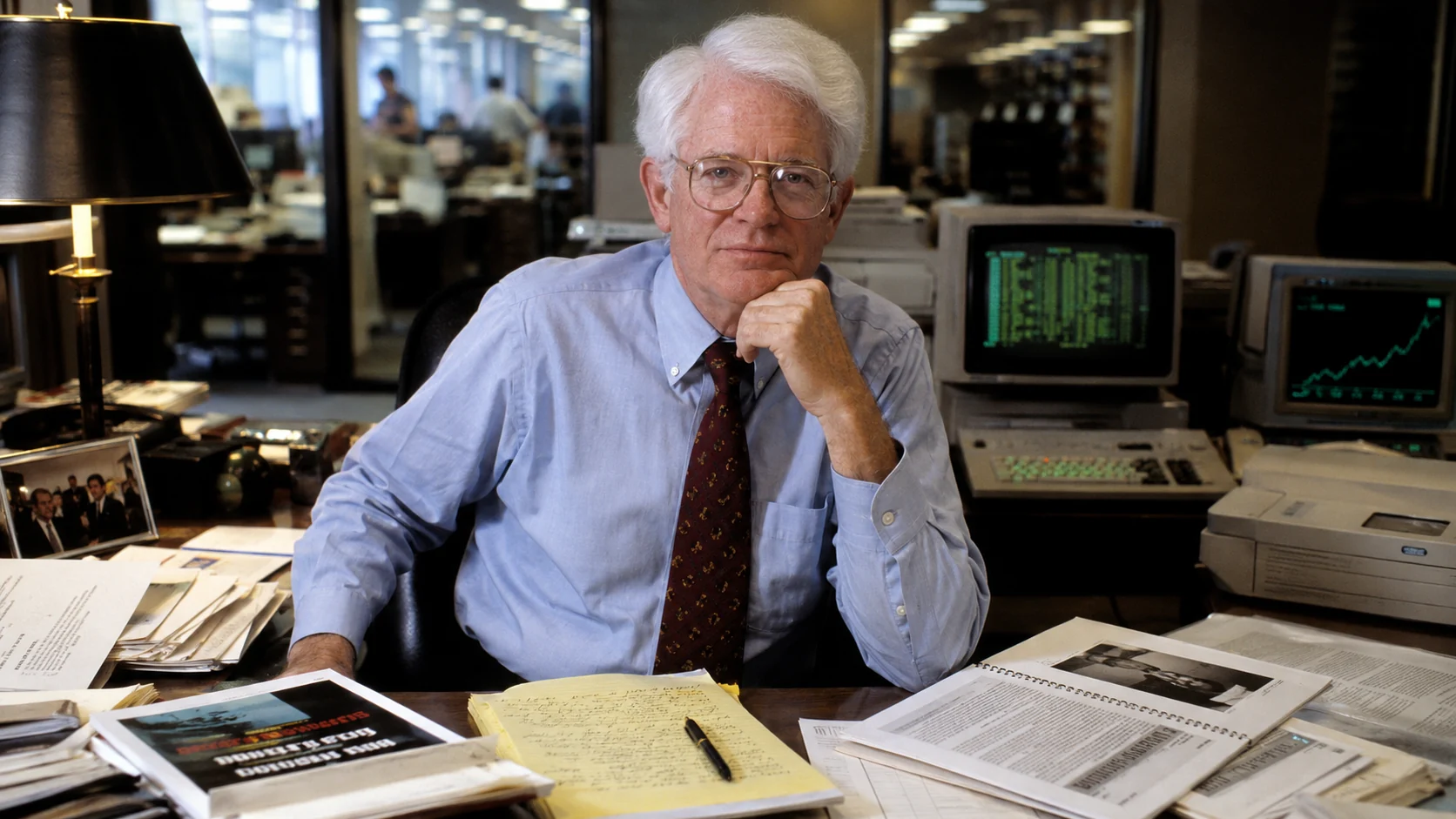
The Investor Who Looked for Stocks in Shopping Malls
Peter Lynch did not believe the best investment ideas always arrived in a research report from Wall Street.
Sometimes they appeared in a shopping mall.
A restaurant.
A hotel.
A supermarket.
A workplace.
Or during an ordinary conversation with someone who understood an industry better than the analysts covering it.
That philosophy eventually became associated with one of the most famous ideas in investing:
Invest in what you know.
But Lynch's actual method was much more sophisticated than the slogan suggests.
He was not telling investors to buy a company simply because they liked its products.
He was saying that ordinary people sometimes encounter important business trends before those trends become obvious to Wall Street.
A nurse may notice a medical product becoming standard inside hospitals.
A contractor may see demand exploding for a particular building material.
A parent may notice the same children's retailer suddenly packed every weekend.
A restaurant customer may discover a chain expanding successfully long before institutional analysts consider it important.
That observation can create an investment lead.
Then the real work begins.
Fidelity still describes Lynch's approach this way: use specialized knowledge to identify companies you are capable of analyzing, then study them and decide whether they are actually worth owning.
That distinction is everything.
Peter Lynch did not become legendary by buying whatever he happened to recognize.
He used recognition to discover where to start looking.
His Track Record Made Wall Street Pay Attention
Lynch took control of Fidelity's Magellan Fund in 1977 when he was only 33 years old.
He managed it until 1990.
During those 13 years, Magellan increased by more than 2,700%, according to a PBS interview with Lynch.
His annualized return was approximately 29.2%, and assets in the fund grew from roughly $18 million when he took over to around $14 billion when he retired as portfolio manager.
That kind of performance creates legends.
But it can also create the wrong lesson.
Lynch did not achieve those results by identifying one miraculous stock and sitting on a beach for 13 years.
He researched an enormous number of companies.
He owned hundreds of stocks at various points.
He looked across industries.
He searched for growth companies, neglected businesses, turnarounds, cyclicals, companies with hidden assets, and established businesses trading at attractive valuations.
Most importantly, he understood that different stocks needed to be evaluated for different reasons.
There was no single Peter Lynch formula.
There was a framework for thinking.
Ordinary Investors Had an Advantage Wall Street Often Ignored
Professional investors possess enormous advantages.
Research databases.
Analysts.
Management access.
Financial models.
Industry conferences.
Technology.
Capital.
Peter Lynch nevertheless believed ordinary investors could possess something professionals sometimes lacked:
direct observation.
Imagine a portfolio manager in Manhattan researching a regional retail chain with 40 locations.
Now imagine someone living near three of those stores.
The local customer may notice that parking lots are suddenly full.
They may see friends becoming obsessed with the brand.
They may know the company opened another location and customers immediately lined up.
They can see the product in the real world before the company's success becomes spectacular enough to dominate Wall Street research.
Lynch believed these observations could produce an information advantage.
Not inside information.
Not secret information.
Public reality that the market had not yet fully appreciated.
He reiterated that philosophy decades after leaving Magellan, arguing that investors should understand the businesses they own and focus on actual companies rather than treating the stock market like a casino.
The advantage was not having more information than Wall Street.
It was sometimes noticing useful information sooner.
“Invest in What You Know” Is Probably Lynch's Most Misunderstood Lesson
Suppose you love Chipotle.
The restaurant is always crowded.
You love the food.
Your friends love it.
Does that mean you should buy the stock?
No.
That would be an incomplete application of Lynch's philosophy.
The restaurant can be excellent while the stock is wildly overpriced.
Revenue can grow while profits disappoint.
Expansion can destroy returns if new stores perform poorly.
Debt can become dangerous.
Competitors can emerge.
Management can allocate capital badly.
Margins can deteriorate.
A wonderful business purchased at an absurd valuation can still produce a disappointing investment.
For Lynch, personal experience created the story.
Financial research had to determine whether the story was supported by reality.
This is why his philosophy contains an important second question:
What does the company actually have to do for this investment to work?
If you cannot explain that clearly, you may not understand the stock well enough to own it.
Lynch Wanted Investors to Know the Story Behind the Stock
A ticker symbol is not a business.
Lynch wanted a simple investment thesis that could explain why earnings might become significantly larger in the future.
Consider a hypothetical restaurant chain with 80 locations.
It operates profitably.
Customers love it.
Management believes the United States can support 800 locations.
New stores produce attractive returns on the capital required to open them.
Debt is modest.
Existing-store sales remain healthy.
Now there is a story.
The company does not need to discover a new planet or invent artificial intelligence.
It may simply need to successfully repeat something that already works.
Open 80 stores.
Then 120.
Then 200.
Then 400.
If revenue and earnings expand alongside the store base, the business can become dramatically larger.
That kind of understandable growth appealed to Lynch.
The best investment stories did not necessarily need to be technologically complicated.
Sometimes boring was beautiful.
He Divided Stocks Into Different Categories
One of Lynch's most useful ideas was that investors should stop treating every company as though it belongs in the same box.
He broadly classified companies into six categories:
Slow GrowersMature companies with relatively modest growth.StalwartsLarge, established businesses capable of respectable but generally not explosive growth.Fast GrowersSmaller or expanding companies capable of significantly increasing earnings.CyclicalsBusinesses whose profits rise and fall heavily with economic or industry cycles.TurnaroundsTroubled companies whose value depends on fixing serious problems.Asset PlaysCompanies possessing assets that the market may be undervaluing or overlooking.
Why does this matter?
Because the same financial number can mean different things for different businesses.
A 10% earnings-growth rate might be excellent for a mature utility but disappointing for a company valued as a hyper-growth business.
A low price-to-earnings ratio might make one company attractive but could signal collapsing profits at a cyclical business near the top of its cycle.
High debt might be manageable for a predictable company and disastrous for a fragile turnaround.
Lynch did not simply ask:
“Is this stock cheap?”
He asked:
“What kind of company is this, and what should I reasonably expect from it?”
That made his analysis contextual rather than mechanical.
Fast Growers Could Produce the Famous “Tenbagger”
Lynch popularized one of investing's most memorable terms:
tenbagger.
A tenbagger is a stock that increases to ten times the investor's original purchase price.
Invest $10,000.
A tenfold increase turns it into $100,000.
Those investments can completely change portfolio mathematics.
If a stock loses 50%, the maximum damage is limited to the amount invested.
A truly extraordinary winner can rise several hundred or even several thousand percent over enough time.
That asymmetry is one reason Lynch was reluctant to automatically sell a successful company simply because the stock had already risen substantially.
A stock doubling does not mean the opportunity is finished if the underlying company still has years of profitable expansion ahead.
Imagine selling a future 20-bagger after the first 100% gain because you were excited to “lock in the profit.”
You were right about the company.
Then behavior prevented you from receiving most of the reward.
This is why finding a winning stock was only half the job.
You also had to hold it while it kept winning.
Lynch Looked for Companies With Room to Repeat Their Success
One of the attractive characteristics of a growth company is what might be called the runway.
Suppose a restaurant concept is successful in Boston.
That proves something.
Suppose it becomes successful across Massachusetts.
That proves more.
But if the company already operates everywhere in America, future growth becomes harder.
Lynch was interested in businesses whose formulas could potentially be repeated many more times.
A retailer with 50 successful stores and room for 1,000 may have a long runway.
A company already operating 20,000 locations needs another engine of growth.
This sounds simple, but it helps explain why relatively unknown companies can sometimes become extraordinary investments.
Wall Street may focus on what the company earns today.
The early investor asks what the company might earn after successfully repeating its model for another decade.
That difference between current scale and potential scale is where some enormous winners are born.
Earnings Had to Eventually Support the Story
Lynch loved stories.
But stories without numbers are dangerous.
If a stock was going to rise dramatically over the long term, he expected the company itself to become more economically valuable.
That generally means earnings matter.
Revenue matters.
Margins matter.
Debt matters.
Cash matters.
Inventory can matter.
The balance sheet matters.
The price paid for the stock matters.
A company whose profits increase substantially over many years has a fundamental reason for becoming more valuable.
A company whose stock price rises while the underlying business goes nowhere increasingly depends on investors simply agreeing to pay more for the same economics.
Those are very different propositions.
Lynch's strategy therefore occupied an interesting middle ground between growth investing and value investing.
He wanted growth.
But he cared about what he was paying for it.
A Great Company Can Still Be a Terrible Investment at the Wrong Price
This is another part of Lynch's philosophy modern investors can easily forget.
Suppose Company A is growing earnings 20% annually.
Fantastic.
Now suppose investors become so excited that the stock trades at an extreme valuation requiring spectacular growth for years merely to justify today's price.
The business can continue succeeding while shareholders earn disappointing returns.
Why?
Because the price already assumed too much success.
This is where Lynch's use of valuation entered the picture.
He often compared a company's price-to-earnings ratio with its expected earnings growth, looking for situations where the stock's valuation seemed reasonable relative to the business's potential.
The framework later became closely associated with the PEG ratio, which compares the P/E multiple with the company's earnings-growth rate.
It is not a magical formula.
Growth estimates can be wrong.
Earnings can deteriorate.
Different industries deserve different valuations.
But the underlying principle is timeless:
How much are you paying for the growth you expect to receive?
Finding the next extraordinary company is not enough.
You also need to avoid paying a price that already assumes the extraordinary outcome.
Boring Companies Could Be Beautiful Investments
Wall Street loves exciting stories.
That can create opportunities elsewhere.
Imagine two companies.
One develops futuristic technology and appears constantly in financial news.
The other manufactures replacement parts for industrial equipment.
Which attracts more investors?
Probably the first.
Which is the better investment?
There is no way to answer without examining the businesses and valuations.
Lynch frequently appreciated businesses with dull names, dull industries, or little institutional excitement precisely because neglect can affect price.
If everyone already knows a company is spectacular, enthusiasm may already be reflected in the valuation.
But a profitable company quietly growing inside an unglamorous industry may attract less competition from investors.
This is one of the central ideas behind finding stocks “before Wall Street notices.”
It is not about possessing secret information.
It is about searching where excitement has not already inflated expectations.
He Loved Businesses That Could Grow Without Constantly Reinventing Themselves
Another attractive business characteristic is simplicity.
Consider a successful retailer expanding geographically.
Its growth formula is understandable:
open another store.
Now another.
Now another.
Compare that with a company needing to invent a revolutionary product every three years just to survive.
The second business may ultimately be much larger.
It also contains a different kind of risk.
Lynch often favored investment theses whose path could be explained without requiring a dozen miracles.
A company did not have to transform civilization.
It needed a profitable model capable of being repeated.
That is powerful because repeatability makes growth easier to analyze.
He Was Willing to Look Where Everyone Else Saw Trouble
Not every Lynch investment was a clean growth story.
Turnarounds represented another category entirely.
These were companies facing serious problems but potentially capable of recovering.
The logic is different.
With a fast grower, the investor might ask:
How large can this company become?
With a turnaround:
Can this company survive long enough to fix itself?
That shifts attention toward debt.
Cash.
Asset sales.
Cost reductions.
Management.
Industry conditions.
Liquidity.
A struggling company can look extraordinarily cheap just before bankruptcy.
So a low stock price alone means nothing.
The potential opportunity comes when the market has priced a business for disaster while the underlying facts begin improving faster than investors realize.
This is much riskier than buying a healthy growth company.
It also illustrates Lynch's flexibility.
He was not searching for one type of stock.
He was searching for situations where reality could eventually become better than the market expected.
Cyclical Stocks Required Understanding the Industry, Not Just the Company
Airlines.
Automakers.
Steel producers.
Commodity businesses.
Homebuilders.
Semiconductor companies in certain periods.
Their earnings can move dramatically with economic conditions, supply, demand, inventories, pricing, and industry capacity.
This creates a trap.
A cyclical company can look statistically cheapest when business conditions are near their strongest.
Profits are enormous.
The P/E ratio looks tiny.
Everyone is optimistic.
Then the cycle turns.
Earnings collapse.
The apparently cheap stock was not cheap at all.
Lynch understood that analyzing these companies required knowledge of the cycle itself.
What are inventories doing?
Is capacity expanding?
Are prices strengthening?
Are competitors adding supply?
Has the industry spent years in a downturn?
Are conditions beginning to improve?
Again, the investor closest to the real industry can sometimes see changes before financial statements fully reflect them.
That is another version of the ordinary investor's potential edge.
“Before Wall Street Notices” Does Not Mean Before Anyone Knows
This distinction deserves emphasis.
Public markets prohibit trading on material nonpublic information.
Peter Lynch's method was built around public observations and fundamental research, not secret corporate information.
Imagine visiting ten locations of a publicly traded retailer.
You notice rising customer traffic.
You read the annual report.
Study margins.
Look at expansion plans.
Examine debt.
Compare valuation with competitors.
Read management commentary.
Everything can be public.
The advantage comes from assembling the pieces intelligently before the consensus catches up.
This is very different from receiving confidential information about next quarter's earnings.
The edge is analytical.
Not illegal.
Lynch Did Not Waste Much Energy Predicting the Economy
One fascinating part of Lynch's approach was his skepticism toward macroeconomic forecasting.
Investors constantly want to know:
When is the recession?
What will the Federal Reserve do?
Where will the market be six months from now?
Will interest rates rise?
When is the next crash?
Lynch repeatedly argued that trying to predict these events could distract investors from understanding businesses.
In his later comments, he continued emphasizing present facts such as industry conditions and employment rather than pretending to know exactly what next year's economy would look like.
This does not mean economic conditions are irrelevant.
A recession can devastate certain companies.
Interest rates affect valuations.
Credit conditions matter.
The insight is different.
You can spend enormous amounts of time predicting macroeconomic events and still be wrong.
Meanwhile, a company's revenue, competitive position, debt, expansion economics, and customer behavior are things an investor can actually investigate.
Lynch preferred facts over forecasts.
The 1987 Crash Tested the Philosophy
Lynch's Magellan tenure was not a straight line upward.
On October 19, 1987, the Dow Jones Industrial Average fell more than 22% in a single trading session.
Black Monday remains one of the most violent market crashes in American history.
Lynch was running an enormous equity portfolio.
The existence of that crash is important because retrospective performance numbers remove the emotional experience required to achieve them.
It is easy to admire a 29.2% annualized record decades later.
It is harder to imagine managing money while billions of dollars in market value disappear during a panic.
Lynch's career demonstrates something that applies far beyond his individual stock selections:
great long-term returns can contain terrifying short-term periods.
A strategy that works only when the market feels comfortable is not much of a strategy.
Finding the Winner Is Easier Than Holding the Winner
Imagine discovering an unknown growth company.
You buy at $10.
The stock reaches $15.
Then $20.
You have doubled your money.
Selling feels intelligent.
After all, nobody ever went broke taking a profit.
But suppose the business keeps expanding.
The stock reaches $40.
Then $70.
Eventually $100.
Your original research was correct.
Yet you captured only a small fraction of the result because success made you nervous.
This is one reason Lynch's tenbagger concept is so useful psychologically.
A gigantic winner cannot become gigantic without first becoming a two-bagger, a three-bagger, and a five-bagger.
You have to survive being right.
Selling every stock immediately after a modest gain virtually guarantees that you will never own a tenbagger for the entire journey.
But this does not mean “never sell.”
If the investment story changes, valuation becomes absurd, growth opportunities disappear, financial conditions deteriorate, or the original thesis proves wrong, the reason for ownership can disappear too.
The goal is not blind loyalty.
It is avoiding the mistake of treating a rising stock price itself as evidence that the investment has finished working.
Lynch's Strategy Required Far More Work Than His Catchphrases Suggest
This is perhaps the most important warning for modern investors.
“Invest in what you know” sounds easy.
It is not.
Peter Lynch ran a professional investment fund.
He examined companies intensely.
He spoke with management teams.
Studied industries.
Read financial reports.
Compared competitors.
Investigated balance sheets.
Followed earnings.
Visited businesses.
Revised his opinions.
The ordinary investor advantage Lynch described was not permission to avoid research.
It was an invitation to begin research from an area where you might already know something useful.
Fidelity's modern description of his philosophy explicitly pairs specialized knowledge with analysis and study.
Buying Nike because you like your shoes is not Peter Lynch investing.
Noticing that a brand appears to be gaining extraordinary consumer traction, then deeply investigating the public company behind it, is closer.
Observation creates the clue.
Research determines whether the clue deserves your money.
Could Lynch's Strategy Still Work Today?
Markets have changed dramatically since Lynch managed Magellan.
Information moves almost instantly.
Alternative data tracks credit-card spending.
Satellites monitor parking lots.
Artificial intelligence can analyze financial statements.
Social media can turn obscure products into worldwide phenomena overnight.
Professional investors possess tools Lynch could barely have imagined in 1977.
That makes some informational advantages smaller.
But it does not necessarily eliminate the basic principle.
Human beings still interact with businesses.
Industries still change gradually before financial results fully reveal the consequences.
New products still become popular.
Regional companies still expand.
Management teams still make good and bad capital-allocation decisions.
Investors still become obsessed with glamorous themes while ignoring boring companies.
Markets remain populated by humans capable of overreacting, underreacting, becoming fearful, and becoming euphoric.
And Lynch himself was still defending the basic philosophy in 2025, saying investors should understand what they own and arguing that ordinary investors can still find opportunities if they know where to look.
The tools changed.
The underlying game did not disappear.
The Hardest Part Is Knowing When You Are Wrong
Every great stock picker has losing investments.
Peter Lynch certainly did.
The existence of tenbaggers does not eliminate companies that fall 50%, 80%, or fail completely.
This is why a stock-picker needs something beyond conviction:
humility.
Imagine buying a retailer because you expect expansion.
Two years later:
new stores are performing badly.
Debt is increasing.
Margins are shrinking.
Customer traffic is weakening.
Management keeps lowering guidance.
The original thesis is disappearing.
An investor can respond in two ways.
The first says:
“I bought at $40 and it is only $22. I refuse to sell until I get my money back.”
The second says:
“The facts that justified my purchase no longer exist.”
The market does not know what price you paid.
Your purchase price has no influence over the company's future.
Lynch's company-focused framework forces investors to return repeatedly to the actual business rather than defend a past decision simply because admitting a mistake is uncomfortable.
Peter Lynch's Real Edge Was Curiosity
The famous slogans make his strategy sound mechanical.
It was actually powered by curiosity.
Why is this store always crowded?
Why are customers switching brands?
Why is this company expanding faster than competitors?
Why are inventories falling?
Why are margins improving?
Why does nobody on Wall Street care?
Why is this company valued like it will never grow again?
Why is this business trading below the value of assets it owns?
Why is everyone convinced this industry is terrible when the underlying numbers are beginning to recover?
Great investing questions often begin with something that does not fit comfortably inside the consensus.
Lynch kept looking for those inconsistencies.
Then he researched them.
That is how an everyday observation could eventually become a portfolio position.
He Did Not Need Every Stock to Become a Winner
This is another important mathematical lesson.
Stock picking does not require perfect accuracy.
Suppose an investor owns ten companies.
Several perform poorly.
Some produce modest returns.
One becomes a tenbagger.
That extraordinary winner can compensate for several mistakes.
This is possible because the downside of an ordinary unleveraged stock investment is ultimately limited to the amount invested, while a successful company can theoretically increase many times in value.
But investors often sabotage this asymmetry.
They hold losers because they hope to “get back to even.”
Then they sell winners because they fear losing an existing profit.
That produces exactly the opposite of what a portfolio needs.
The losers receive unlimited patience.
The winners receive none.
Lynch understood that truly exceptional companies require room to become exceptional investments.
The Biggest Lesson Was Never “Find the Next Hot Stock”
The title of Lynch's most famous book, One Up on Wall Street, captured his belief that ordinary investors could sometimes possess advantages professionals overlooked.
But his philosophy has almost nothing in common with chasing whatever stock is currently going viral.
He wanted investors to start with reality.
Understand the product.
Understand the company.
Understand how it makes money.
Understand what must happen for earnings to grow.
Understand the balance sheet.
Understand the valuation.
Understand the risks.
Then wait.
That final part matters.
Wall Street can notice a company tomorrow.
The stock does not necessarily become a tenbagger tomorrow.
Business growth takes years.
Stores need to open.
Customers need to arrive.
Profits need to expand.
Competitive advantages need to survive.
A winning stock often becomes obvious only after much of the winning business has already been built.
Peter Lynch's great skill was recognizing some of those businesses while their future still looked ordinary.
What Peter Lynch Actually Saw Before Everyone Else
He did not possess a crystal ball.
He saw customers.
Stores.
Products.
Expansion.
Earnings.
Balance sheets.
Industries.
Management decisions.
Valuations.
And occasionally, he saw a gap between what a company was becoming and what the stock market still believed it was.
That gap is the opportunity every stock picker dreams of finding.
Lynch proved that sophisticated investing does not always begin with sophisticated information.
Sometimes it begins with noticing something ordinary.
But turning that observation into money requires the part people often leave out when repeating his famous advice:
research.
The customer may discover the company.
The financial statements must justify the stock.
The valuation determines what you are paying.
And patience determines whether a great idea ever has enough time to become a tenbagger.
That is how Peter Lynch found winning stocks before Wall Street fully noticed them.
Not by knowing the future.
By paying unusually close attention to the present.
In One Up on Wall Street, Peter Lynch and John Rothchild lay out the philosophy behind this approach in Lynch's own voice, explaining how ordinary investors can use what they encounter in everyday life to discover potential opportunities before they become obvious on Wall Street. More importantly, the book shows why noticing a great company is only the beginning: the real advantage comes from researching it well enough to know whether the stock deserves your money.
Sources
Fidelity — Peter Lynch's “Invest in What You Know” Approach
PBS FRONTLINE — Interview With Peter Lynch
The Wall Street Journal — Peter Lynch: It's Not Just “Invest in What You Know”
This article was written by the owner of Finance Atlas. The information presented was researched using the authoritative sources listed above.
Continue Reading