
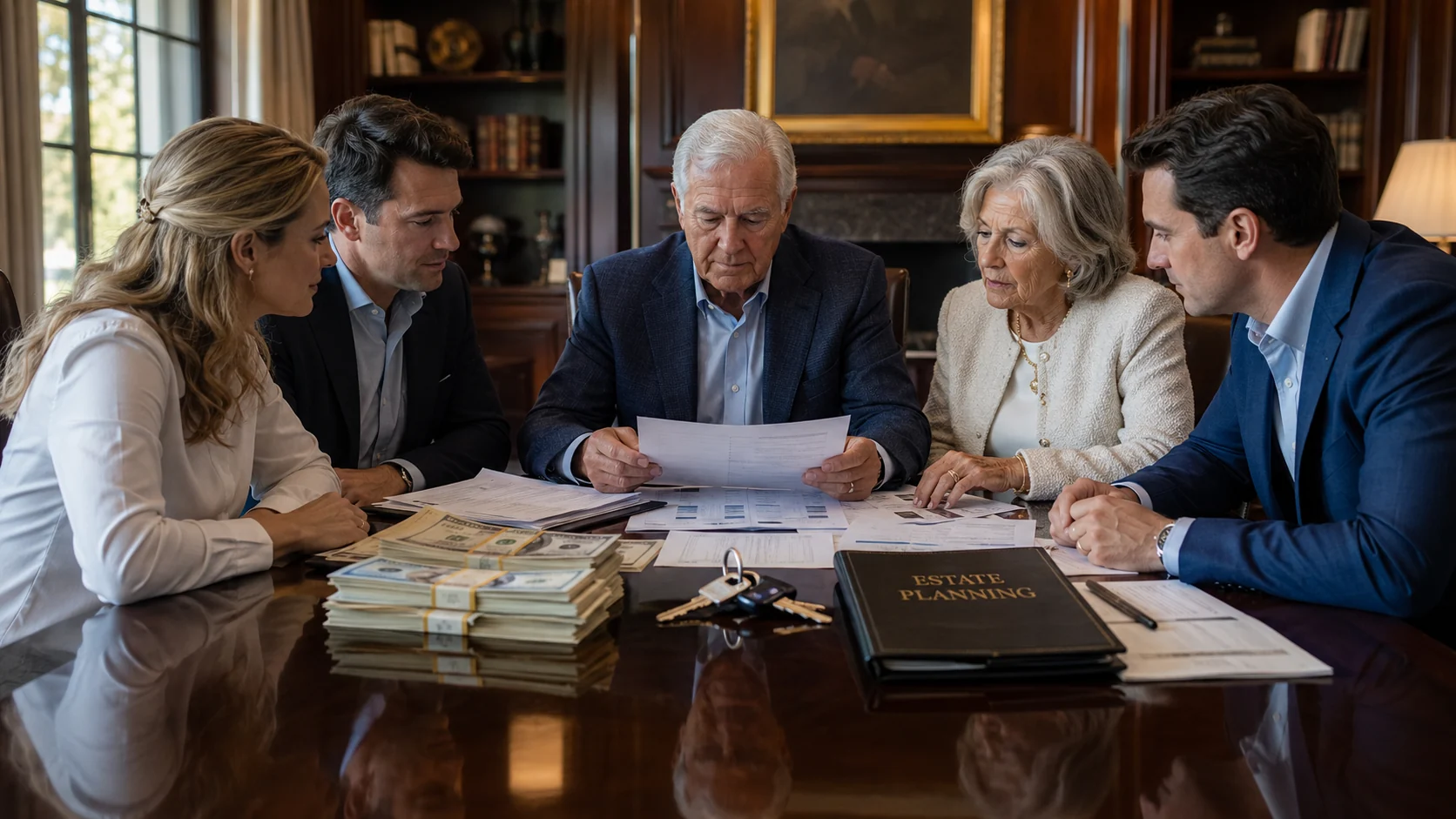
America Is About to Move a Fortune Without Making Everyone Rich
Somewhere in America, a house bought for $70,000 decades ago is now worth $700,000. A retirement account that began with modest payroll contributions has compounded through years of market gains. Shares purchased long before a company became a household name are sitting inside a brokerage account. A family business, a rental property, farmland, cash, bonds, and insurance policies have accumulated quietly around the lives of people who are now entering their seventies, eighties, and nineties.
One by one, those assets will change hands.
Taken together, the numbers are almost difficult to absorb. Cerulli Associates estimates that roughly $124 trillion in wealth will be transferred through 2048, with about $105 trillion expected to go to heirs and roughly $18 trillion to charities. Nearly $100 trillion of the total is projected to come from Baby Boomers and generations older than them.
It has been called the Great Wealth Transfer, and the phrase can create a seductive picture: an enormous reservoir of American wealth finally flowing toward younger generations that have spent years coping with expensive housing, student debt, childcare costs, financial crises, and a retirement system increasingly dependent on personal savings.
But that picture leaves out the most important part of the story.
The money is not sitting in one giant national account waiting to be divided among every Millennial and Gen Xer. It belongs to individual families, and American wealth is extraordinarily unevenly distributed. The people whose parents own businesses, large securities portfolios, valuable real estate, and other appreciating assets are positioned to inherit very differently from people whose parents have little wealth beyond Social Security income, a modest home, or no meaningful assets at all.
That distinction changes everything.
The Great Wealth Transfer may indeed become one of the largest movements of private wealth in American history. But it is also likely to reveal, with unusual clarity, something that headline numbers can hide: a generation can inherit trillions while millions of people within that same generation inherit little or nothing.
The $124 Trillion Number Is Enormous, but It Is Not What It First Appears to Be
To understand what is happening, the first step is to separate the size of the transfer from the distribution of the transfer.
Cerulli's projection stretches through 2048. This is not $124 trillion suddenly landing in the bank accounts of young Americans. The estimate includes wealth transferred over roughly a quarter century, and a large portion of the money will move through complicated family pathways before reaching younger heirs.
Cerulli estimates that approximately $54 trillion will first move through transfers between spouses. Nearly $40 trillion of those spousal transfers is expected to go to widowed women among Baby Boomers and older generations. Only later may much of that wealth move down to children or other heirs.
That creates a transfer with several stages.
A husband may die and leave most assets to his wife. Years later, she may transfer the remaining estate to children, grandchildren, charities, or trusts. Some assets will be gifted while their owners are still alive. Some will be consumed during retirement. Some families will sell property. Others will preserve businesses or investment portfolios for another generation.
The transfer, in other words, is less like one enormous inheritance event and more like a slow migration of ownership.
Even the generational labels can conceal important timing differences. Cerulli projects Millennials will ultimately inherit more than any other generation over the full period, about $46 trillion, while Generation X is expected to receive the largest amount in the nearer term. Cerulli estimated Gen X would receive approximately $14 trillion over the following decade, compared with about $8 trillion for Millennials during that same period. A later Cerulli analysis estimated Gen X households could receive roughly $1.4 trillion per year on average over the next decade.
So the Great Wealth Transfer is already underway, but it will not arrive everywhere at once.
And the biggest dividing line is not necessarily age.
It is whether a family has substantial wealth to transfer in the first place.
The Statistic That Changes the Entire Story: Two Percent of Households
Buried inside the enormous $124 trillion projection is a number that may explain more about the Great Wealth Transfer than the headline itself.
Cerulli estimates that more than half of the total transfer, approximately $62 trillion, will come from households currently classified as high-net-worth or ultra-high-net-worth. Those households represent only about 2 percent of all households.
That is the gravitational center of the story.
A transfer can be historically large without being broadly distributed. If an enormous share of the assets originates inside a very small group of wealthy families, then a similarly enormous share of the eventual inheritance will remain connected to those families.
The Federal Reserve's latest Distributional Financial Accounts make the concentration visible from another angle. In the first quarter of 2026, the top 10 percent of households by wealth collectively held roughly $118.3 trillion in net worth. The bottom 50 percent held about $4.27 trillion. Taken against roughly $174 trillion across the groups shown in the Fed's table, the top tenth controlled about 68 percent, while the bottom half controlled roughly 2.5 percent.
Those numbers describe wealth today, not a forecast of who will inherit each future dollar. But they explain why the inheritance boom cannot be understood simply by dividing trillions by the number of people in younger generations.
Families cannot bequeath assets they do not own.
If one household owns a multimillion-dollar stock portfolio and several properties while another reaches retirement with little accumulated wealth, the adult children in those families may be the same age and live in the same city, yet their financial futures can unfold on entirely different tracks.
That is how a Great Wealth Transfer can simultaneously make one group of Americans dramatically wealthier and leave another group wondering where the supposed inheritance boom went.
What Is Actually Being Inherited?
The word "inheritance" often brings cash to mind. Much of the Great Wealth Transfer will not arrive as cash.
It will arrive as ownership.
The Federal Reserve's 2026 data show how differently assets are distributed across wealth groups. Among the wealthiest Americans, corporate equities and mutual fund shares account for enormous amounts of household assets. Business ownership is also heavily concentrated toward the top. Real estate, meanwhile, is important across a much broader portion of the population.
That distinction matters because inheriting a $500,000 house is not the same experience as receiving $500,000 in cash. The heir may live in the property, rent it, sell it, divide its value with siblings, pay maintenance expenses, deal with a mortgage or other obligations, or discover that the emotional value of a family home complicates what looks straightforward on paper.
A privately held business can be even more complex. Its stated value may be substantial, but the wealth can be tied to employees, equipment, customers, real estate, debt, and the ability of someone to continue operating the company. A valuable family business cannot necessarily be sliced into equal pieces without changing the business itself.
Investment portfolios create different possibilities. Stocks and funds are liquid compared with real estate or private companies. They can remain invested, produce dividends, be sold in portions, or become the foundation of another generation's portfolio.
This is one reason inherited wealth can have effects far beyond the amount listed on an estate statement. Ownership of appreciating assets can continue to compound.
An heir who receives a portfolio does not merely receive yesterday's wealth. If the assets remain productive, that person may also receive decades of future returns.
The Most Powerful Inheritance May Arrive Before Anyone Dies
There is another flaw in the popular image of inheritance: wealthy families do not necessarily wait until death to transfer economic advantage.
Money can move between generations long before an estate is settled.
Parents can help with college expenses. They can provide a down payment for a first home. They can assist with childcare, cover an emergency, invest in a child's business, guarantee a loan, pay for professional training, or simply give an adult child enough financial breathing room to take a career risk.
Even when no check changes hands, family wealth can change behavior.
A 30-year-old who knows that parents can help during an emergency faces a different financial landscape from a 30-year-old who knows that an emergency at home may require sending money in the opposite direction.
One person can leave a bad job without immediately fearing eviction. Another cannot. One can start a business knowing there is a family safety net. Another must protect every paycheck. One can buy a home with help on the down payment while another continues renting and watching home prices rise.
None of this means the person receiving family help has not worked hard. It means effort operates inside different financial conditions.
Inheritance therefore should not be understood only as the moment an executor distributes an estate. Intergenerational wealth can influence opportunity years before the formal inheritance occurs.
By the time millions of dollars finally change legal ownership, some of their economic effects may already have been present for decades.
Why Baby Boomers Hold So Much of the Wealth That Is Moving
The size of the transfer is partly a demographic story.
Baby Boomers, generally defined as Americans born between 1946 and 1964, moved through adulthood during decades in which the United States experienced enormous growth in asset values. Many bought homes that appreciated substantially. Some accumulated retirement savings through employer plans and individual investment accounts. Others built businesses, acquired property, purchased stocks, or benefited from long periods of economic expansion.
That does not mean every Boomer became wealthy. Far from it. There are older Americans with inadequate retirement savings, renters with little accumulated net worth, and households whose assets may be substantially consumed by living costs before anything reaches the next generation.
But enough wealth accumulated among older households, particularly at the upper end of the distribution, to create a transfer measured not in billions but in tens of trillions of dollars.
There is also a compounding effect hidden inside the story.
Imagine two families beginning several decades ago. One buys a home and gradually builds retirement investments. The other remains financially fragile and is unable to accumulate significant assets. Over time, home appreciation and investment returns can increase the distance between them. When the older generation eventually dies, the first family's accumulated advantage does not disappear. It can pass to the next generation.
Then the process can begin again.
The child who inherits assets has capital available for investing, housing, education, entrepreneurship, or simply financial security. If that capital continues growing, the eventual grandchildren may inherit from an even stronger position.
Wealth has memory.
The Transfer Could Divide Millennials More Than It Unites Them
Millennials are often discussed as though they share one financial destiny. They do not.
Two Millennials of identical age can have similar salaries and dramatically different balance sheets. One may carry student loans, rent an apartment, and support aging parents. Another may earn the same amount but own a home partly financed by family assistance, have no education debt, and expect to inherit an investment portfolio.
Their incomes may look similar on a spreadsheet.
Their economic lives are not.
Cerulli's projection that Millennials will eventually inherit approximately $46 trillion is therefore both meaningful and easy to misinterpret. It says something enormous about the total amount expected to reach that generation. It does not mean the typical Millennial will receive anything close to an equal share.
The likely result is a widening distinction within generations themselves.
There will be Millennials who become property owners because of inheritance and Millennials who remain locked out of expensive housing markets. There will be families able to fund education for the next generation without borrowing and families for whom tuition remains a major financial burden. There will be entrepreneurs who can use inherited capital to build companies and workers who cannot afford to lose a month of income.
The Great Wealth Transfer may therefore create a strange economic reality: people commonly described as belonging to the same generation may increasingly live in separate financial worlds.
Race Is Also Part of the Inheritance Story
The distribution of wealth in America has never developed in a historical vacuum, and the inheritance discussion cannot be separated completely from longstanding racial differences in household wealth.
According to the Federal Reserve's 2022 Survey of Consumer Finances, median wealth was approximately $285,000 for White families, $44,900 for Black families, and $61,600 for Hispanic families. The Fed described the typical White family's wealth as roughly six times that of the typical Black family and about five times that of the typical Hispanic family. The same survey estimated median wealth of roughly $536,000 among Asian families, although the Fed notes important differences within broad racial categories.
Those disparities do not mean every household within a racial group shares the same experience. Wealth distributions vary enormously inside every group, and broad racial categories can conceal major differences in income, immigration history, geography, education, homeownership, business ownership, and family circumstances.
But the national gaps matter because inheritance begins with existing assets.
When one group historically has more accumulated household wealth available to transfer, the next generation has a greater opportunity to receive that wealth. In that sense, inheritance can carry parts of yesterday's economic structure into tomorrow.
The process does not require a conspiracy or a secret mechanism. It can happen through ordinary family decisions: a house goes to children, investments go to beneficiaries, a business stays in the family, grandparents pay tuition, or parents help finance a first property.
Private decisions can be entirely understandable at the family level while still producing major consequences when repeated millions of times across a country.
Women Will Control a Huge Share of the Wealth Before It Reaches Younger Heirs
One of the most significant parts of the Great Wealth Transfer receives less attention than the battle between Boomers, Gen X, and Millennials.
A massive amount of wealth is expected to move first between spouses.
Cerulli estimates $54 trillion will pass through inter-spousal transfers through 2048, and more than 95 percent of that amount is expected to go to women. The firm projects that nearly $40 trillion will move first to widowed women in Baby Boomer and older generations before much of the wealth eventually travels elsewhere.
This means women are not merely one group of eventual heirs in the transfer. Many will become central decision-makers in what happens next.
They may decide how portfolios are invested, when properties are sold, how much wealth is given to children during their lifetimes, what goes to charity, how family businesses are handled, and what remains in the estate.
For financial institutions, that creates a commercial battle. Wealth managers who spent decades building a relationship primarily with one spouse cannot assume the assets will remain with the same firm after that client dies.
For families, the consequences are more personal. A surviving spouse may suddenly become responsible for financial structures previously managed by someone else. Decisions that once belonged to a couple can become the responsibility of one person.
The Great Wealth Transfer is therefore not simply a transfer from old people to young people.
A large part of it will first be a transfer from one spouse to another.
The Tax System Determines How Some Fortunes Cross Generations
Whenever enormous inheritances are discussed, estate taxes quickly enter the conversation. But the federal estate tax applies to a much narrower group of estates than many people assume.
For 2026, the IRS lists the federal basic exclusion amount at $15 million for an individual estate, up from $13.99 million for 2025. Estates below the applicable federal filing threshold generally do not face federal estate tax solely because an inheritance exists.
That high threshold matters to the Great Wealth Transfer because the transfer itself is so concentrated.
For a middle-class family passing down a home and ordinary savings, federal estate tax may never become the central issue. For families controlling tens or hundreds of millions of dollars, estate planning can become an industry unto itself, involving attorneys, accountants, trusts, gifting strategies, charitable planning, insurance, business succession structures, and investment management.
The distinction illustrates another way wealth can compound into infrastructure.
Large fortunes can support the professional systems needed to preserve large fortunes.
That does not mean every planning strategy eliminates taxes, nor does it mean every wealthy family follows the same approach. Tax treatment depends heavily on circumstances, ownership structures, state law, asset type, timing, and legislation. But sophisticated estate planning can determine whether a family business survives intact, whether assets must be sold, when heirs receive control, and how wealth is divided across generations.
A fortune is therefore not transferred by a single signature on a will.
Behind very large estates can be years, sometimes decades, of planning.
Who Is Most Likely to Benefit?
The clearest beneficiaries are heirs connected to families that already own substantial assets.
That sounds obvious, but it is the essential point obscured by generational headlines.
A Millennial born into a household with $20 million in investable assets belongs to the same generation as a Millennial whose parents have negative net worth. Calling both members of the generation expected to inherit trillions tells us very little about either person's actual prospects.
Gen X appears positioned to feel the transfer first on a large scale. Millennials are projected to receive more over the entire transfer period. Women are expected to gain control of a remarkable amount through spousal and intergenerational transfers. Charitable organizations are also projected to receive a significant portion of the wealth.
There is another beneficiary that rarely appears in the family tree: the financial industry.
Banks, investment managers, financial advisors, trust companies, estate attorneys, accountants, insurance providers, and family offices all have an economic interest in the movement of these assets. When trillions change owners, the institutions that manage those trillions can change as well.
This explains why the Great Wealth Transfer has become such a major subject inside wealth management.
The transfer is not only a demographic event.
It is a competition for control of capital.
And Who Will Be Left Behind?
The simplest answer is also the harshest: people whose families have little wealth to transfer.
Millions of Americans will move through the same decades in which $124 trillion changes hands without receiving a life-changing inheritance.
Some will inherit sentimental possessions but little financial wealth. Others may receive a modest share of a family home after it is divided among siblings. Some may receive assets only after years of helping support parents financially. Some families may see much of their accumulated wealth consumed during retirement.
And many younger Americans will inherit nothing substantial at all.
The Federal Reserve's wealth distribution helps explain why. If the bottom half of households collectively holds only a small fraction of total household net worth, there simply is not an enormous pool of wealth available for that half to pass down.
That does not mean people in the bottom half are permanently trapped there. People build wealth, businesses succeed, careers change, markets move, homes appreciate, debts are repaid, and households can climb the distribution over time.
But inheritance introduces something fundamentally different from earned income.
You cannot work harder to change how wealthy your parents were before you were born.
That is why inheritance occupies such an uncomfortable place in American ideas about economic opportunity. The United States celebrates individual effort, entrepreneurship, risk-taking, and self-made success. Families, at the same time, naturally want to help their children and preserve what they spent a lifetime building.
Both ideas can be true.
The tension appears when inherited capital becomes large enough to influence access to homes, education, investments, businesses, neighborhoods, professional networks, and future inheritances themselves.
A House Can Change a Family's Future More Than a Headline Fortune
The Great Wealth Transfer does not require a billionaire inheritance to change a life.
Consider a family home.
Suppose an adult child who has been renting inherits a mortgage-free house. That person has several choices. Live in it and eliminate a major monthly expense. Rent it and create an income stream. Sell it and invest the proceeds. Use the equity as part of a broader financial strategy.
Now imagine another person earning exactly the same salary who receives nothing.
From that point forward, their financial paths can diverge even if neither changes jobs.
The first person may suddenly have hundreds of thousands of dollars in home equity and no rent. That freed cash flow can go toward retirement investments. Those investments can compound. Eventually, the first person's children may inherit both the remaining property wealth and the investment portfolio built from the cash flow the property made possible.
One inheritance can create another.
This is why moderate inheritances matter enormously even though billion-dollar estates attract the headlines.
For an ordinary household, $100,000 or $300,000 received at the right time can alter a mortgage, retirement plan, education decision, or business opportunity. It may not create a private jet. It can still change a family's trajectory.
The Great Wealth Transfer Will Not Necessarily Make Younger Americans Feel Rich
There is another paradox hiding inside the trillions.
An individual can inherit substantial wealth and still live in an economy where the price of the things that create financial security has increased dramatically.
A home in an expensive metropolitan area can absorb hundreds of thousands of dollars. College costs can consume a significant family budget. Childcare, insurance, and retirement savings compete for the same income.
As a result, some inheritances that sound enormous in isolation may function less like entry into the wealthy class and more like a bridge into conventional middle-class security.
A $150,000 inheritance might become a home down payment, debt reduction, and retirement contributions. That can be transformative. It is not the same as inheriting a $15 million portfolio.
Once again, averages blur the difference.
The phrase "Millennials will inherit trillions" can simultaneously describe a person who inherits a family business worth tens of millions of dollars and another who receives $25,000 from a grandparent's estate.
Their names may appear in the same generational column.
Economically, they inhabit different planets.
What Could Change the $124 Trillion Forecast?
The $124 trillion estimate is a projection, not a vault whose contents have already been counted and assigned.
Over the next two decades, asset prices will move. Stock markets will rise and fall. Real estate values will change. Families will spend money during retirement. Businesses will succeed or fail. Charitable giving will alter estates. Tax rules may change again. People may live longer than expected and consume more of their assets.
That uncertainty does not make the Great Wealth Transfer imaginary. It means the final number should be understood for what it is: an estimate based on current wealth, demographics, and expected transfer patterns.
Cerulli itself has revised wealth-transfer estimates over time as household wealth and market conditions changed.
So the significant fact is not that exactly $124 trillion must move.
It is that America has accumulated an enormous amount of private wealth among generations now entering the period when ownership inevitably changes.
The transfer is demographic gravity.
The exact landing point is still being determined.
This Is Ultimately a Story About Who Owns Assets
The debate around inheritance can easily become moral theater.
One side can portray inherited wealth as evidence that capitalism is fundamentally rigged. Another can treat any criticism of inheritance as an attack on a family's right to pass property to its children.
Reality is more complicated.
Families have powerful and understandable reasons to support the people they love. Parents who spent decades building a business or saving money commonly want their children to benefit from that effort.
At the same time, when ownership is highly concentrated, the transfer of that ownership can reproduce part of the same concentration into the next generation.
The Great Wealth Transfer does not create America's wealth distribution from scratch.
It inherits it.
That may be the most important sentence in the entire story.
The transfer is not a national lottery that randomly assigns yesterday's fortunes to tomorrow's adults. Wealth follows legal ownership, beneficiary designations, family relationships, wills, trusts, gifts, and charitable decisions. In most cases, assets travel along lines established long before the moment of inheritance.
So the economic question is not simply how much money will move.
It is where the money begins.
The Real Divide May Be Between Heirs and Everyone Else
For much of the twentieth century, discussions of inequality centered heavily on wages: who earned more, who earned less, which jobs paid well, and whether incomes were rising.
Those questions remain important. But the Great Wealth Transfer puts balance sheets under a brighter light.
Income tells you how much money flows into a household.
Wealth tells you what the household already owns.
A person earning $100,000 a year with no assets and significant debt is not in the same position as a person earning $100,000 who owns a home outright and has a million-dollar investment portfolio. Their paychecks are identical. Their financial resilience is not.
Inheritance can widen that distinction overnight.
For some Americans, the next quarter century will bring property, investment accounts, businesses, and financial cushions accumulated by previous generations. For others, the same period will require building wealth almost entirely from wages and personal savings while competing in the same housing and investment markets.
That is where the Great Wealth Transfer may leave its deepest mark.
Not simply between Boomers and Millennials.
Not simply between old and young.
But between Americans who begin the next chapter of their lives with inherited capital and Americans who do not.
The Trillions Will Move, but Opportunity Will Not Move With Them Equally
By 2048, the ownership map of American wealth could look very different.
Many of today's largest asset holders will be gone. Their homes will have new names on the deeds. Their stocks will sit in different brokerage accounts. Their companies may belong to children, employees, competitors, or investors. Their charitable gifts may finance universities, hospitals, foundations, religious institutions, community organizations, and other causes.
Women will control a large portion of wealth once managed by husbands. Gen X will pass through the first major wave of inheritances. Millennials will eventually receive the largest projected generational share. Financial institutions will fight to keep assets as they change owners.
Yet one fact is unlikely to disappear simply because the names on the accounts change.
The starting point is unequal.
Federal Reserve data show a country in which wealth remains heavily concentrated. Cerulli's transfer estimates show that more than half of the projected transfer volume originates with just a small fraction of households. Put those facts together and the phrase "Great Wealth Transfer" takes on a different meaning.
It will be great in size.
It will not necessarily be broad in reach.
For readers who want to go beyond the numbers and wrestle with the deeper question of whether inherited wealth is simply a legitimate extension of private property or a mechanism that can reproduce inequality across generations, Daniel Halliday's The Inheritance of Wealth: Justice, Equality, and the Right to Bequeath is a particularly relevant continuation. The book examines inheritance not merely as a tax problem but as a question about opportunity, family rights, economic segregation, and what happens when large advantages can survive from one generation to the next.
The Great Wealth Transfer will be described for years in trillions of dollars. But its real consequences will be measured in smaller moments: who can buy a house, who can start a company, who can retire safely, who can help a child through college, who can withstand a financial emergency, and who begins adulthood knowing that substantial capital is eventually coming.
The money will move.
The more important question is whether the distance between families moves with it.
Sources
Cerulli Associates, Cerulli Anticipates $124 Trillion in Wealth Will Transfer Through 2048 Cerulli Associates report and findings
Board of Governors of the Federal Reserve System, Distribution of Household Wealth in the U.S. since 1989 Federal Reserve Distributional Financial Accounts
Internal Revenue Service, Estate Tax IRS estate tax information and 2026 threshold
This article was written by the owner of Finance Atlas. The information presented was researched using the authoritative sources listed above.
Continue Reading