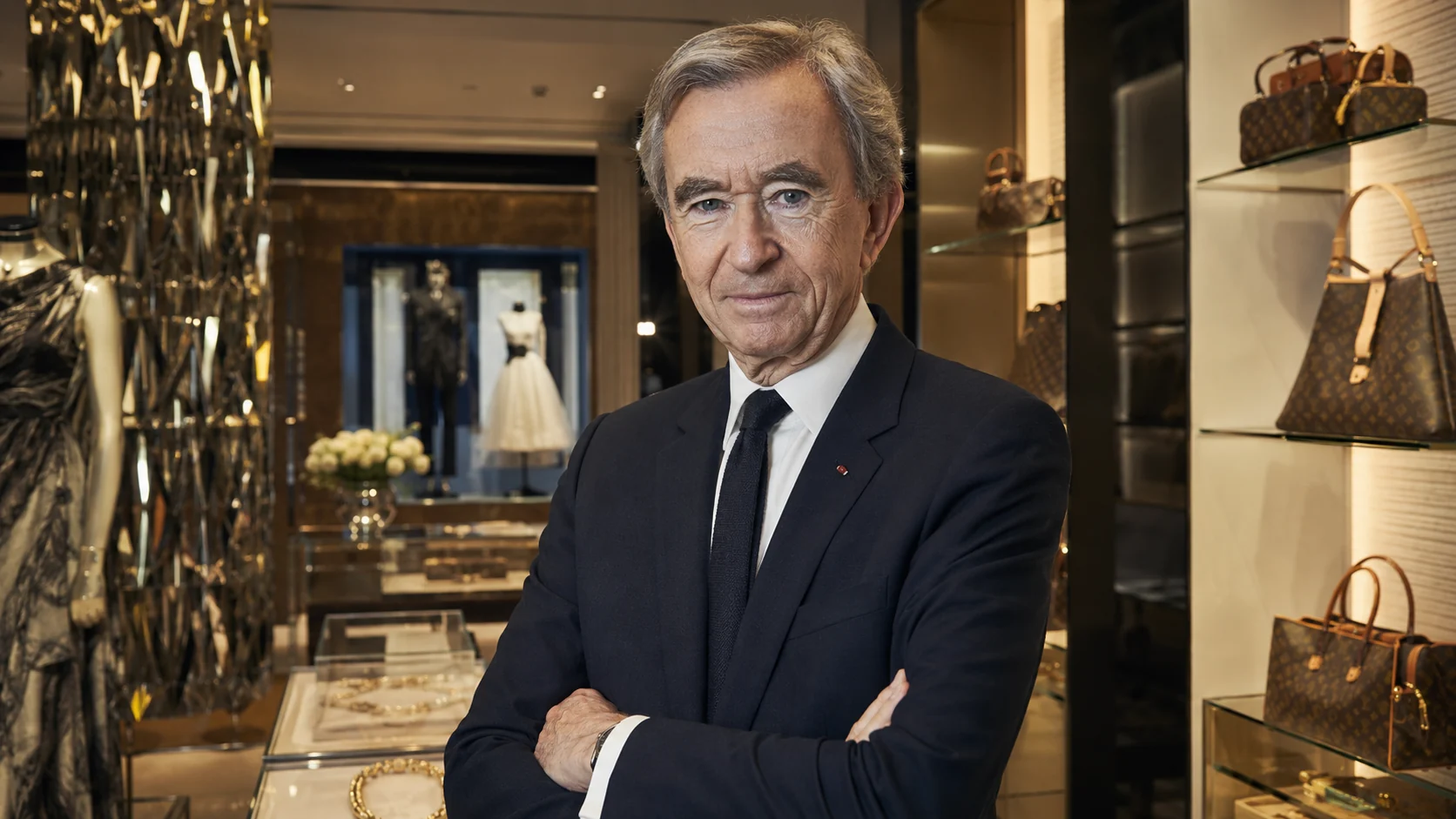
The Man Who Realized Luxury Could Become an Empire
Bernard Arnault did not invent Louis Vuitton.
He did not create Dior.
He did not establish Moët & Chandon, Hennessy, Tiffany & Co., Bulgari, Fendi, Givenchy, Celine, or Loewe.
Many of the brands that eventually made him one of the most powerful businessmen in the world existed long before he was born.
Arnault's genius was different.
He understood that luxury brands could be treated as extraordinarily valuable economic assets without destroying the history, craftsmanship, mystique, and creative identity that made them desirable in the first place.
That balance is difficult.
Conventional corporations usually seek efficiency through standardization. Combine factories. Centralize decisions. Reduce duplication. Make every division operate according to one system.
Luxury works differently.
A customer paying thousands of dollars for a Dior dress or Louis Vuitton handbag does not want to feel that it came from an anonymous corporate machine.
The product needs a story.
Heritage.
Scarcity.
Craftsmanship.
Status.
Emotion.
Arnault built LVMH by placing dozens of individual worlds under one enormous financial roof while trying to preserve the illusion that each Maison still lived inside its own universe.
In 1987, when LVMH was formed through the merger of Moët Hennessy and Louis Vuitton, the group contained 10 Maisons, approximately 12,000 employees, and €3 billion in sales. Today it contains more than 75 Maisons across fashion, leather goods, wine and spirits, perfumes, cosmetics, watches, jewelry, retail, hospitality, and other activities.
That transformation was not the result of one brilliant fashion collection.
It was the product of an acquisition strategy pursued for almost four decades.
Dior Was the Door Into Luxury
Arnault did not begin his career surrounded by champagne bottles and haute couture.
Born in Roubaix, France, in 1949, he studied engineering at École Polytechnique and joined his family's construction business, Ferret-Savinel. By 1978, he had become chairman.
Then came the move that changed everything.
In 1984, Arnault took control of Financière Agache and reorganized the troubled business around an asset he considered exceptionally valuable:
Christian Dior.
Dior was not simply another clothing company.
The name had history.
Recognition.
Prestige.
Emotional value.
Arnault saw something that would define much of his later career: a luxury brand can possess value far beyond the factories, inventory, and buildings on its balance sheet.
A factory can be copied.
A famous brand with decades of cultural meaning cannot be reproduced so easily.
LVMH's own account of Arnault's career describes Christian Dior as the cornerstone of the luxury strategy he began developing during this period.
Dior taught Arnault the formula.
Acquire something rare.
Protect what makes it rare.
Modernize the business around it.
Expand globally.
Then repeat.
LVMH Already Existed. Arnault Took Control of It.
LVMH was created in 1987 through the merger of two established groups.
One side contained Louis Vuitton, the famous luggage and leather-goods house.
The other combined Moët & Chandon champagne with Hennessy cognac.
It was already an impressive collection of luxury assets.
It was also politically complicated.
The merger brought powerful executives, families, shareholders, and competing visions into the same organization.
Arnault saw an opportunity.
Rather than founding a rival luxury conglomerate one brand at a time, he accumulated enough LVMH stock to become its controlling force.
By 1989, he had become LVMH's majority shareholder and its chairman and CEO.
That moment matters because Arnault was not simply inheriting a finished luxury empire.
He was taking possession of the platform from which one could be built.
Then the shopping began.
He Built LVMH One Legendary Name at a Time
Arnault's acquisition strategy eventually resembled a collector assembling priceless art, except each painting produced cash flow.
LVMH added Loewe and Celine in 1996.
The group expanded further into watches and jewelry, including TAG Heuer in 1999.
It acquired Fendi in 2001.
Bulgari joined in 2011.
German luxury-luggage maker Rimowa arrived in 2016.
Luxury hotel and travel group Belmond joined in 2019.
And in 2021, LVMH completed the acquisition of American jeweler Tiffany & Co., adding one of the most recognizable luxury names in the United States to its portfolio.
The pattern is important.
Arnault was not buying dozens of interchangeable businesses.
He was collecting categories of desire.
Louis Vuitton could dominate leather goods.
Dior could span couture, accessories, cosmetics, and perfume.
Moët & Chandon offered champagne.
Hennessy offered cognac.
Bulgari expanded jewelry.
TAG Heuer strengthened watches.
Sephora provided beauty retail.
Belmond moved the group into luxury travel.
Tiffany gave LVMH an extraordinary position in American jewelry.
Each acquisition placed another piece of the luxury economy inside the same corporate system.
Tiffany Revealed the Scale of Arnault's Ambition
The Tiffany acquisition was especially revealing.
LVMH did not need Tiffany to survive.
It already possessed jewelry brands.
It was already enormous.
But Tiffany offered something that cannot simply be manufactured in a laboratory: almost two centuries of history and one of the most recognizable identities in American luxury.
The little blue box alone carries meaning.
That is exactly the kind of asset Arnault values.
Reuters ranked LVMH's Tiffany transaction among the largest luxury deals in modern history, alongside Arnault's earlier consolidation of Christian Dior.
The strategy was not:
Buy a jewelry company.
It was:
Own a piece of cultural real estate inside the customer's mind.
Then invest heavily enough to make that real estate more valuable.
That distinction explains much of LVMH.
Arnault Does Not Want the Brands to Look Like LVMH
This sounds paradoxical, but it may be one of the group's greatest strengths.
Most customers do not wake up thinking:
“I want to buy an LVMH product today.”
They want Louis Vuitton.
Dior.
Tiffany.
Bulgari.
Fendi.
Dom Pérignon.
The corporate parent intentionally remains less visible than many of the brands it controls.
That allows every Maison to maintain a distinct identity.
LVMH itself describes its development model as acquiring brands, giving them access to the group's capabilities, and nurturing growth while respecting their individual identities.
That matters enormously in luxury.
Imagine if every LVMH store had the same design.
Every advertisement looked identical.
Every handbag followed the same aesthetic.
Every brand shared the same celebrity ambassadors.
The financial efficiencies might improve.
The magic would evaporate.
Arnault's conglomerate therefore operates differently from a conventional industrial empire.
The corporate structure is enormous.
The customer experience remains fragmented intentionally.
Behind the curtain sits LVMH.
In front of it sits the Maison.
The Empire Creates Advantages Individual Luxury Houses Cannot Easily Match
Keeping brands creatively distinct does not mean there are no advantages to enormous scale.
Quite the opposite.
A luxury house inside LVMH can benefit from access to capital, global retail expertise, prime real estate relationships, talent recruitment, logistics, technology, advertising capability, and decades of experience operating across international markets.
Imagine a prestigious but relatively small fashion house trying to expand into New York, Tokyo, Shanghai, Dubai, Paris, London, and Seoul independently.
Every city creates new problems.
Where should the flagship store be located?
How much should be invested?
Which customers matter most?
How should products be distributed?
How should local marketing work?
How much inventory is appropriate?
LVMH has already solved versions of those problems repeatedly.
That creates an institutional advantage.
The group can own many independent creative identities while sharing the invisible infrastructure required to turn them into global businesses.
Luxury on the outside.
Industrial-scale capability underneath.
Arnault Understood That Luxury Must Resist Normal Business Logic
Ordinary businesses usually want to sell as many units as possible.
Luxury has to be more careful.
Sell too little and the business remains tiny.
Sell too much and exclusivity can disappear.
This creates one of the strangest problems in capitalism:
How do you grow enormously without looking mass-market?
That has been one of LVMH's great skills.
A Louis Vuitton handbag must be available enough to produce billions in revenue but exclusive enough that owning it still communicates status.
Dior needs global scale without feeling ordinary.
Tiffany needs thousands of customers without making its jewelry feel industrial.
The company therefore cannot pursue volume at any price.
Desirability comes first.
When customers begin purchasing primarily because an item is cheap, the luxury equation has already started breaking.
Arnault's empire is built around protecting that equation.
Price Is Part of the Product
For most products, a lower price makes the offer more attractive.
Luxury can behave differently.
Price itself sends a signal.
A $30 handbag can be functional.
A $3,000 handbag is communicating something else.
Craftsmanship may be superior, materials may be exceptional, design may be distinctive, and the brand may possess enormous heritage.
But economics alone cannot explain the entire price difference.
Part of the price represents meaning.
This is where luxury businesses become extraordinary.
They sell physical products whose perceived value can rise dramatically because of brand, scarcity, history, cultural relevance, craftsmanship, and status.
That gives successful luxury houses potentially remarkable pricing power.
Arnault understands that lowering prices to chase volume can damage the very asset producing the premium.
Luxury does not merely sell a product.
It sells permission to enter a story.
Control Over Distribution Protects the Story
Where a luxury product is sold matters almost as much as what it is.
Imagine a rare handbag stacked between discount appliances inside a warehouse store.
The bag itself has not changed.
Its psychological value probably has.
That is why luxury groups care obsessively about distribution.
Flagship stores are not merely places to hold inventory.
They are theaters.
Architecture.
Lighting.
Music.
Service.
Product placement.
Location.
The experience reinforces what the customer is supposed to believe about the object being purchased.
This is also why LVMH's ownership of Sephora is strategically fascinating.
Arnault did not limit the empire to producing luxury goods.
The group also expanded into the infrastructure through which prestige beauty is sold.
Luxury ownership moved both upstream and downstream.
Create desire.
Create products.
Control more of the customer experience.
Creativity Is Treated as an Economic Asset
Luxury companies live in an uncomfortable relationship with history.
Heritage creates value.
Too much reverence for history creates irrelevance.
A brand founded 100 or 150 years ago still needs a 25-year-old customer to care about it today.
That requires creative reinvention.
LVMH repeatedly puts major creative personalities in charge of its houses and allows them to reinterpret old codes for new generations.
The Louis Vuitton monogram can remain recognizable while the surrounding fashion changes dramatically.
Dior can preserve references to Christian Dior while new designers rebuild silhouettes, handbags, campaigns, and runway collections.
This is not artistic experimentation detached from economics.
Creativity creates demand.
A successful designer can make a decades-old brand suddenly feel culturally urgent again.
Arnault therefore treats creative talent almost the way a technology company treats elite engineers.
It is a scarce resource capable of changing the economics of the business.
LVMH Learned to Sell Culture Around the Product
Another part of Arnault's strategy is making LVMH brands exist beyond stores.
Fashion shows become global media events.
Celebrities become ambassadors.
Architecture becomes marketing.
Art exhibitions create cultural legitimacy.
The Fondation Louis Vuitton in Paris, initiated by Arnault and opened in 2014, placed the group's name beside art, architecture, and cultural patronage rather than simply handbags and champagne.
LVMH later became a major partner of the Paris 2024 Olympic and Paralympic Games and entered a 10-year global luxury partnership with Formula 1 beginning in 2025.
This is not accidental.
Luxury brands become stronger when they occupy culture.
The product begins appearing beside art, sport, film, music, celebrity, architecture, and travel.
Eventually the brand becomes larger than any individual object it sells.
That cultural presence is extraordinarily difficult for a new competitor to reproduce quickly.
You can launch a handbag company tomorrow.
You cannot launch 150 years of mythology tomorrow.
The Portfolio Gives Arnault Another Powerful Weapon
A single luxury brand lives and dies largely according to one category.
LVMH does not.
If champagne struggles, beauty may perform better.
If fashion slows, jewelry may strengthen.
If one geographic market weakens, another may improve.
The group spans Fashion & Leather Goods, Watches & Jewelry, Wines & Spirits, Perfumes & Cosmetics, Selective Retailing, and other luxury businesses.
That diversification does not eliminate risk.
Luxury spending remains exposed to economic cycles, tourism, currencies, consumer confidence, China, the United States, and geopolitical shocks.
But LVMH can absorb problems differently from a company dependent on one label.
The portfolio is both an empire and a shock absorber.
The Numbers Show What Arnault Actually Built
The original LVMH of 1987 recorded roughly €3 billion in sales from 10 Maisons.
For 2025, LVMH reported €80.8 billion in revenue and operated a retail network exceeding 6,280 stores worldwide.
Even during a difficult luxury environment, the machine remained enormous.
In the first half of 2026 alone, LVMH generated €38.6 billion in revenue, €8.7 billion in recurring operating profit, €5.7 billion in group net profit, and €4.1 billion in operating free cash flow. Its Watches & Jewelry division posted 9% organic growth during the period, helped by strong performances from Tiffany and Bvlgari, while Sephora continued growing.
Those numbers reveal what Arnault accomplished more clearly than his personal fortune ever could.
He turned luxury into industrial-scale economics without completely industrializing the customer's perception of luxury.
That is the trick.
The Empire Is Powerful Because Its Best Assets Are Almost Impossible to Recreate
Suppose a competitor has $20 billion.
It can build factories.
Hire designers.
Open beautiful stores.
Spend billions on advertising.
Purchase high-quality materials.
What it cannot simply purchase from scratch is the year 1854, when Louis Vuitton founded his house.
Or 1946, when Christian Dior established his fashion house.
Or almost two centuries of Tiffany's place in American jewelry culture.
History creates scarcity.
That makes great luxury brands unusual assets.
A technology can become obsolete.
A factory depreciates.
A machine wears out.
But managed carefully, heritage can become more valuable as it becomes older.
Arnault built an empire around assets that time itself can strengthen.
Then he applied modern capital, marketing, distribution, management, and global expansion to them.
Old stories.
New money machine.
But Arnault's Model Is Not Invincible
The luxury empire carries real vulnerabilities.
Its products are discretionary.
Consumers do not need another handbag during a recession.
China's luxury demand can change.
Tourism can weaken.
Currency movements can hurt reported results.
Aggressive price increases can eventually alienate aspirational buyers.
Creative directors can fail.
A prestigious acquisition can be overpriced.
A famous brand can lose cultural relevance.
Counterfeiting remains an enormous challenge.
And scale itself can create tension.
The bigger a luxury group becomes, the more carefully it must prevent customers from feeling that exclusivity has become manufacturing theater.
LVMH's 2026 results still showed these pressures. Fashion & Leather Goods revenue was down 1% organically during the first half even though the second quarter finally returned to growth, while reported group revenue declined because of currency and perimeter effects.
Luxury empires require constant maintenance.
Desire has no permanent patent.
There Is One Asset LVMH Eventually Has to Replace: Bernard Arnault
Arnault's extraordinary tenure creates another problem.
He has led LVMH since 1989.
At some point, someone else has to.
That transition matters because so much of the group's identity has been shaped by his judgment about acquisitions, executives, designers, brands, capital allocation, and long-term strategy.
All five of Arnault's children now work within the group, and LVMH's governance has been structured to preserve long-term family influence. Yet no public successor to Bernard Arnault has been named. In 2026, some institutional investors told Reuters that the lack of clarity around succession was becoming a governance concern.
That may ultimately become the greatest test of the empire.
Can Arnault build something capable of outliving Arnault?
The strongest luxury houses already have.
Louis Vuitton survived Louis Vuitton.
Dior survived Christian Dior.
Tiffany survived Charles Lewis Tiffany.
If LVMH is truly an institution rather than the extension of one extraordinary dealmaker, it will eventually have to accomplish the same thing.
Bernard Arnault's Real Product Is Desire
At first glance, LVMH is a strange collection.
Handbags.
Champagne.
Perfume.
Hotels.
Watches.
Makeup.
Jewelry.
Cognac.
Fashion.
Beauty stores.
What unites them?
Not materials.
Not manufacturing.
Not even customers.
The common product is desire.
Every successful LVMH Maison owns a small piece of something people want for reasons extending beyond practical utility.
A Louis Vuitton bag carries objects.
Thousands of cheaper bags can do that.
A Tiffany diamond is carbon.
A watch tells time.
Champagne is a beverage.
Luxury begins when utility stops explaining the price.
Arnault understood this earlier and more aggressively than almost anyone.
He did not build his empire by asking only how many products LVMH could sell.
He asked how much cultural and emotional value a brand could accumulate without losing its exclusivity.
Then he bought more brands capable of accumulating it.
He gave them capital.
Expanded their stores.
Recruited creative talent.
Protected their identities.
Pushed them into new markets.
Connected them to culture.
And repeated the process for decades.
That is why LVMH became more than a conglomerate.
It became a portfolio of myths with balance sheets attached.
Bernard Arnault's greatest accomplishment was not owning dozens of luxury brands.
It was discovering how to make those brands enormously bigger without allowing customers to feel that they had become ordinary.
That tension between scale and scarcity is the engine beneath the entire LVMH empire.
And mastering it is what turned an engineer from northern France into the architect of the most powerful luxury group the world has ever seen.
In Deluxe: How Luxury Lost Its Luster, Dana Thomas explores the transformation of luxury from small, often family-run houses into a global industry dominated by powerful conglomerates, including the rise of figures such as Bernard Arnault. It is a fascinating next read for anyone who wants to understand the machinery, ambition, and contradictions hiding behind the polished storefronts of modern luxury.
Sources
LVMH — 2026 First-Half Results
Reuters — LVMH Investors Seek Clarity on Bernard Arnault Succession
This article was written by the owner of Finance Atlas. The information presented was researched using the authoritative sources listed above.
Continue Reading