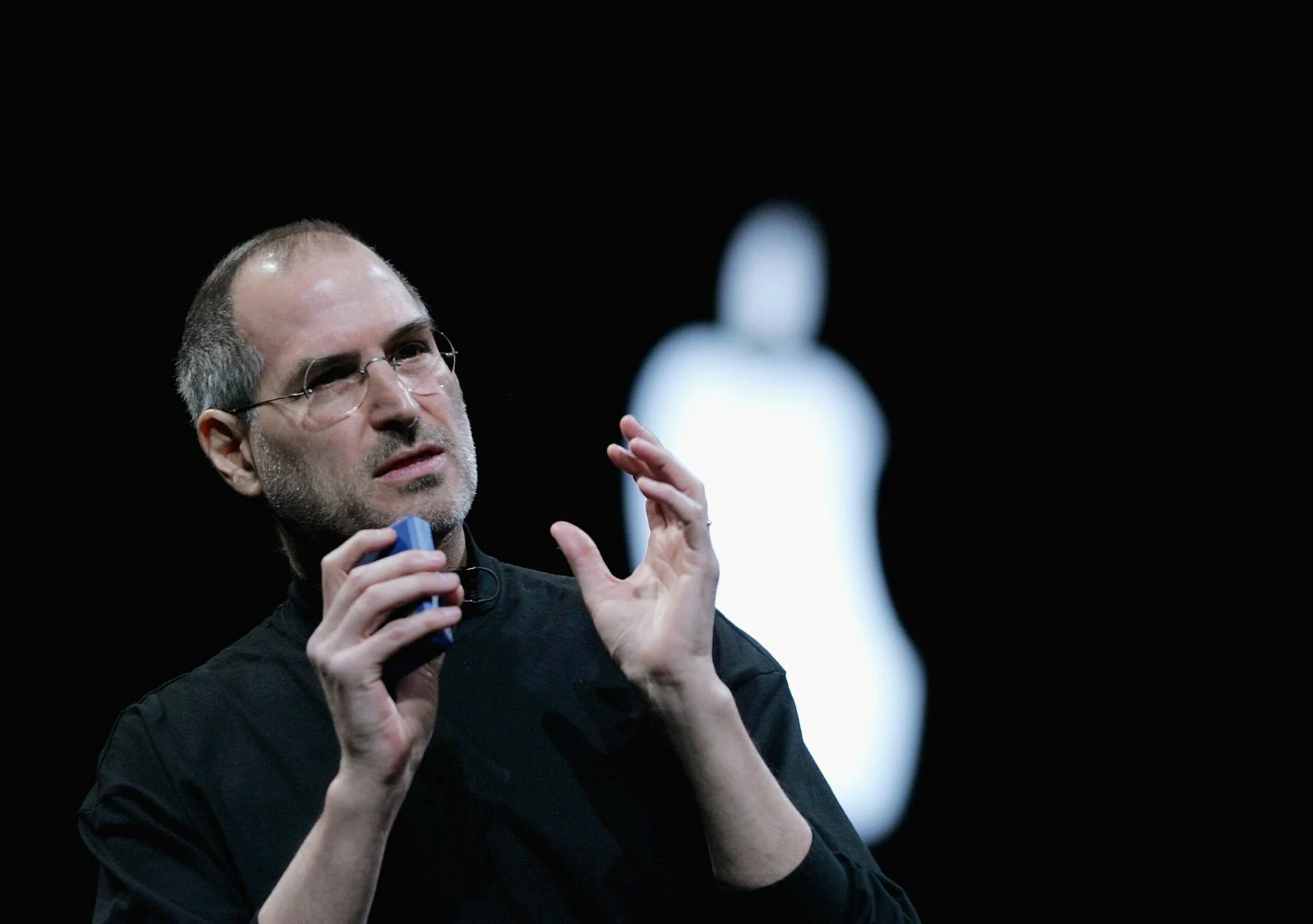
Steve Jobs was 30 years old when he lost control of the company he had helped build from a garage.
Apple was already a major technology business. The Macintosh had introduced millions of people to a more visual and intuitive style of computing, and Jobs had become the public face of a company that promised to think differently.
Then internal conflict left him outside Apple.
Most founders never receive a second chance after losing their own company. Jobs did—and he returned with something he did not possess the first time: the experience of failure.
Apple made him famous.
Losing Apple changed the kind of leader he would become.
Apple Began With Two Different Strengths
Steve Jobs and Steve Wozniak co-founded Apple in 1976, along with Ronald Wayne, who left the company shortly afterward.
Wozniak was the engineering talent behind the earliest Apple computers. Jobs understood something equally important: technology did not need to remain a hobby for specialists. It could become a product ordinary people wanted inside their homes.
The Apple I was sold largely as a circuit board. The Apple II became a more complete consumer product, helping Apple grow quickly and attracting professional investment.
Jobs was not the person building every component. His gift was seeing what the pieces could become when design, engineering, marketing, and presentation worked together.
Plenty of people can recognize good technology.
Jobs was unusually skilled at recognizing when technology was ready to become a story customers could understand.
The Macintosh Revealed His Vision—and His Weaknesses
Jobs became deeply involved in the development of the Macintosh, introduced in 1984.
The computer used a graphical interface and mouse at a time when many personal computers still depended heavily on typed commands. Jobs wanted the product to feel approachable, carefully designed, and different from the machines sold by more conventional technology companies.
His standards helped produce distinctive products, but they also made him difficult to manage. Former colleagues have described him as demanding, impatient, persuasive, and capable of changing direction suddenly.
Those qualities could push a team beyond what it believed was possible.
They could also exhaust people and create conflict.
Vision is valuable inside a company. It becomes dangerous when the person carrying it believes disagreement is proof that everyone else lacks vision.
He Recruited the Executive Who Helped Push Him Out
As Apple expanded, Jobs helped recruit John Sculley from PepsiCo to become the company’s chief executive.
Jobs reportedly wanted an experienced executive who could bring greater discipline to a rapidly growing business. The relationship initially appeared strong, but the two eventually disagreed over strategy, management, and Jobs’ role.
Macintosh sales initially failed to meet some of Apple’s expectations, increasing pressure inside the company. In 1985, Apple’s board supported Sculley during the power struggle and removed Jobs from meaningful operational control.
Jobs later described the experience plainly in his Stanford commencement address: he had been fired from the company he started. He soon resigned and sold most of his Apple shares.
He had helped create the company’s identity.
He no longer controlled where that identity was going.
Losing Apple Freed Him to Begin Again
Public failure can feel worse than private failure because everyone sees the distance between who you were and who you have become.
Jobs had gone from celebrated young founder to an outsider watching Apple continue without him.
But he did not leave technology.
He founded NeXT, a computer company aimed largely at education and business customers. NeXT’s computers were beautifully designed and technically ambitious, but expensive and commercially limited.
Judged only by hardware sales, NeXT was not the success Jobs wanted.
Its software became far more important.
NeXT developed an advanced operating system and attracted talented engineers. Years later, that technology would become one of the main reasons Apple brought Jobs back.
A business can fail at the product it originally tried to sell and still create the asset that changes its future.
Pixar Proved He Could Build Beyond Apple
Jobs also purchased the computer graphics division that became Pixar.
For years, Pixar required investment without guaranteeing a major return. Its technology business struggled, but the company’s animation team continued developing films.
The release of Toy Story in 1995 transformed Pixar. It became the first fully computer-animated feature film and a major commercial success. Pixar’s public offering helped make Jobs a billionaire.
This mattered beyond the money.
Jobs had now succeeded outside Apple. He had supported a company where technology and creativity were inseparable—the same combination he had always wanted Apple to represent.
By the time Apple needed him again, he was no longer simply the founder who had been rejected.
He had built evidence that his instincts could create value somewhere else.
Apple Bought NeXT—and Brought Jobs Back
By the mid-1990s, Apple was struggling.
Its product line had become confusing, competition from Windows-based computers had intensified, and the company needed a modern operating system.
Apple acquired NeXT in 1997, bringing its technology and employees into the company. The deal also returned Jobs to Apple as an adviser. He soon became interim chief executive and later resumed the permanent CEO role. Apple’s regulatory filings confirm that Jobs returned in 1997, initially serving as interim CEO.
The irony was difficult to miss.
Apple had once decided it could continue without Steve Jobs.
Years later, it purchased his company partly to obtain the technology it needed to survive.
Jobs did not return by forcing his way through the front door.
He built something Apple eventually needed badly enough to invite him back.
His First Move Was to Remove Things
Apple did not need more ideas when Jobs returned.
It needed fewer distractions.
The company was selling too many computers with confusing names and overlapping purposes. Jobs simplified the product strategy into a small grid focused on consumer and professional customers, with desktop and portable options.
Projects were canceled. Product lines disappeared. Resources were concentrated around a much smaller number of priorities.
This is one of the least glamorous parts of a turnaround.
People often imagine innovation as adding something new. Jobs understood that struggling companies may first need to stop funding things that no longer deserve to exist.
Focus is not deciding what matters.
It is accepting that many other things must receive less attention.
The iMac Made Apple Visible Again
In 1998, Apple introduced the iMac.
Its colorful, translucent design looked unlike the beige computers surrounding it. The machine combined hardware, software, and internet connectivity in a product that was easy to recognize and easy to explain.
The iMac did more than generate sales. It reminded customers that Apple still knew how to create desire around a computer.
Jobs also rebuilt Apple’s public identity through the “Think Different” campaign. The message placed Apple alongside creative figures who challenged convention, helping restore an emotional connection between the company and its customers.
The product and advertising worked together.
The iMac showed what Apple made.
“Think Different” explained what owning it was supposed to say about you.
NeXT Became the Foundation of Apple’s Future
The technology Apple acquired with NeXT contributed to the development of Mac OS X, released in 2001.
That software foundation later evolved across Apple’s broader ecosystem. The acquisition had not simply returned Jobs to the company; it supplied technology and engineering talent that helped modernize Apple’s products. Apple’s SEC filings also document multiple senior engineers who joined after the NeXT acquisition.
This is what made Jobs’ years away so important.
He did not return to recreate the Apple of 1984.
He brought back technology developed during the period when Apple no longer wanted him.
The exile became part of the rescue.
Apple Stopped Being Only a Computer Company
Once the Mac business stabilized, Apple began expanding beyond personal computers.
The iPod arrived in 2001, combining hardware with iTunes to make digital music simpler to organize and carry. Apple later developed the iTunes Store, creating a more complete system connecting devices, software, and content.
The iPhone followed in 2007, combining a phone, an iPod, and internet communication inside a touchscreen device. Apple presented it not simply as another phone but as a new way to interact with mobile software.
Jobs’ strategy was not to make isolated devices.
He wanted Apple to control enough of the hardware and software to shape the entire experience.
Competitors often sold components.
Apple increasingly sold a system in which each product made the others more useful.
Jobs Did Not Build the Comeback Alone
The popular version of Apple’s history can make it appear that Jobs personally invented every product and rescued the company through force of will.
That is not accurate.
Apple’s turnaround depended on thousands of employees and important leaders in design, engineering, software, operations, retail, marketing, and finance. People such as Jony Ive and Tim Cook helped create products and systems that Jobs could not have built alone.
Jobs’ contribution was not doing everyone’s work.
It was aligning talented people around a limited number of products and refusing to accept compromises he believed would weaken the result.
That leadership style produced extraordinary work, but it could also be harsh. Jobs should not be turned into a flawless business hero merely because the products succeeded.
A person can be brilliant at building companies and still leave damage inside the process.
Human stories become less useful when success is allowed to erase every difficult part of the person who achieved it.
He Took Back Apple by Becoming More Useful to It
Steve Jobs did not regain Apple through ownership. By the time he returned, he no longer held the large founding stake that might have given him control.
He regained influence because the company needed what he had developed: NeXT’s software, his product judgment, his ability to simplify decisions, and his talent for making technology feel culturally important.
The first version of Jobs believed his vision should be enough.
The returning version arrived with vision supported by experience, technology, relationships, and another successful company.
He had learned that being right about a product does not automatically make someone capable of leading an organization.
Losing Apple did not make him easier.
It made him more prepared.
The Company He Lost Became the Company Only He Could Rebuild
The most remarkable part of Steve Jobs’ story is not that he founded Apple.
Many people build successful companies.
It is that he was pushed out, spent more than a decade creating elsewhere, and returned when Apple was weak enough to need him but still strong enough to be saved.
His second period at Apple produced the iMac, iPod, iTunes, iPhone, iPad, and a business model built around tightly connected products and services. Apple’s own design retrospective describes the period beginning with the 1998 iMac as two decades of major product development shaped by close collaboration across its teams.
Jobs built Apple once through ambition.
He rebuilt it through focus.
The first time, he wanted to prove that personal computers could change the world. The second time, he understood that a company also has to survive long enough to keep changing it.
Being removed from Apple looked like the end of his greatest work.
It became the experience that prepared him to finish it.
Sources
Stanford University — Steve Jobs’ 2005 Commencement Address
U.S. Securities and Exchange Commission — Apple Corporate History and Steve Jobs’ Return
Apple — Twenty Years of Apple Product Design
This article was written by the owner of this website using information researched from the sources listed above.
Continue Reading